


Gachibowli & Kondapur: Hyderabad’s Original IT Spine — and Why It Still Leads India’s GCC Real Estate Story
Hyderabad Micro-Market Series | Part 4 | Real Estate Digest | April 2026
If there is one corridor in Indian real estate that has consistently outperformed expectations over the last decade, it is the Gachibowli–Kondapur belt in western Hyderabad. What began as a government-planned IT township in the early 2000s has evolved into the country’s most concentrated Global Capability Centre (GCC) hub — a 5-kilometre stretch where the world’s largest corporations have planted their most strategic operations. For real estate investors, end-users, and NRIs evaluating Indian property markets, this corridor demands serious attention in 2026.
The GCC Engine: Why This Corridor Is Different
Most real estate micro-markets ride on infrastructure announcements or developer pipelines. Gachibowli rides on something far more durable — permanent employment density. Microsoft, Google, Amazon, Infosys, TCS, Wipro, Cognizant, Qualcomm, and over 355 other GCCs have established not just offices but multi-building campuses here, housing tens of thousands of high-income professionals within a short commute of the residential belt.
The scale of this concentration became even clearer in 2025. Hyderabad’s office market closed the year with its highest-ever annual gross leasing of 12.44 million square feet — and the Gachibowli corridor alone absorbed 45% of all city-wide office leasing. Grade-A+ office vacancy in the corridor stands at just 9.1% — the tightest in the entire city. When office space is this absorbed, there is simply no slack in the residential rental market nearby. Every new GCC employee added to a campus is a potential tenant looking for housing within 10–15 minutes of their office.
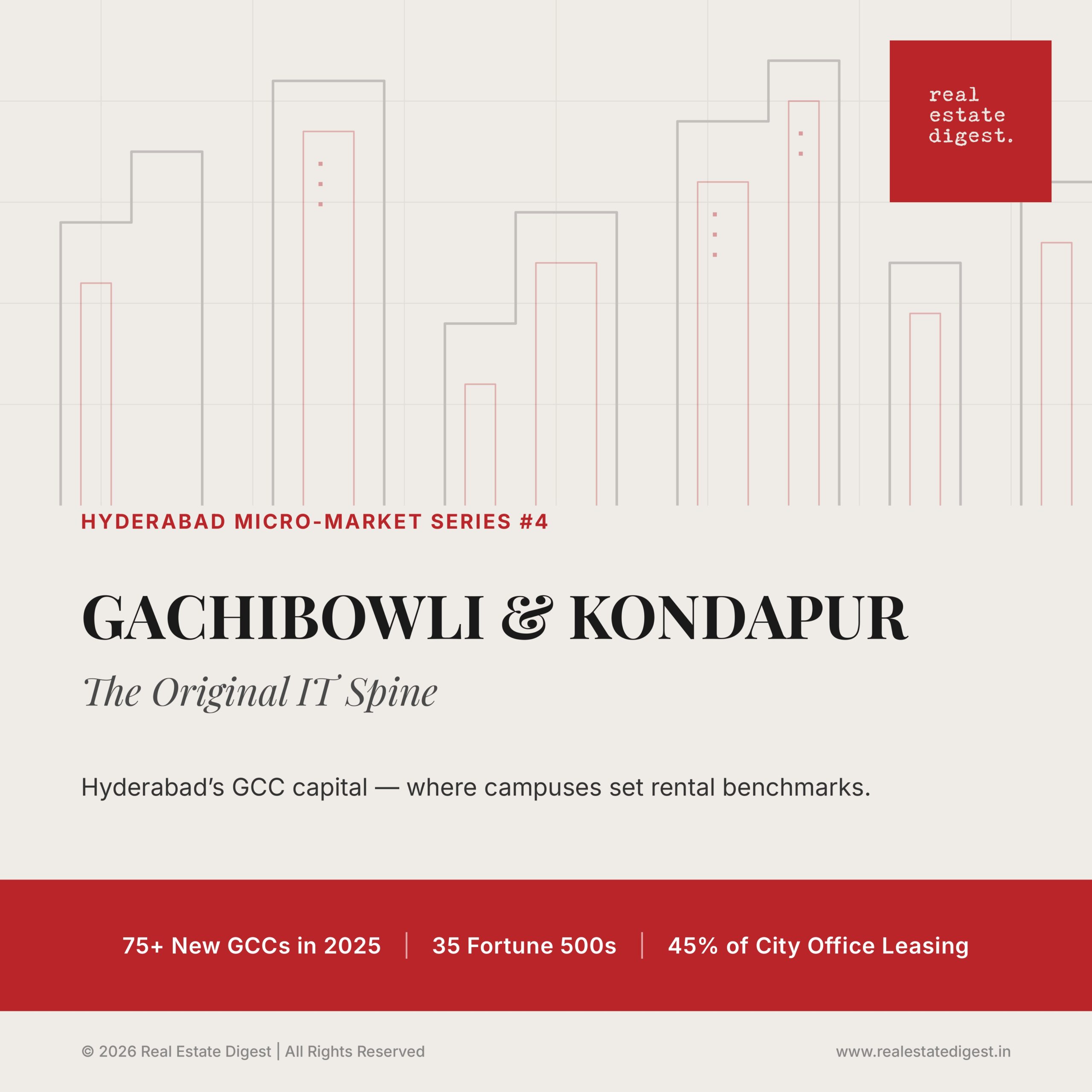
What makes 2025–26 particularly significant is the diversification of this demand. Beyond Big Tech, Hyderabad added 75 new GCCs in 2025 alone, of which 35 were Fortune 500 companies — the largest single-year influx ever recorded. New entrants are no longer just software companies: Eli Lilly and Medtronic have arrived from life sciences, Bosch from engineering, and Vanguard from financial services. This diversification is critical — it means the corridor’s employment base is no longer dependent on a single industry cycle.
Gachibowli: The Rent Optimiser’s Address
For investors whose primary objective is rental income and capital growth, Gachibowli remains the gold standard in Hyderabad.
Pricing and Capital Appreciation
The verified market average for residential apartments in Gachibowli stands at approximately ₹11,100 per square foot, with a price range of ₹9,500–₹12,000 depending on project tier and age. Premium new-launch projects at the top of the market touch ₹13,000 per square foot and above, though this reflects the luxury segment rather than the broad market.
Capital appreciation has been exceptional by any standard. The 6-year compounded annual growth rate (CAGR) for Gachibowli residential property is 15.2% — a figure that comfortably beats most equity mutual fund benchmarks over the same period. On an annual basis, the corridor has been appreciating at 13–15% YoY in the current cycle, supported by persistent demand-supply imbalance and the continued influx of GCC employees.
Rental Yield and Growth
The rental story is where Gachibowli truly stands apart. Rental yields in the corridor currently range from 3.8% to 5%, with premium furnished units touching 6% — well above the Hyderabad city average and competitive with most tier-1 cities in India. More strikingly, rental values grew 24% year-on-year in 2025 — the highest rental growth rate recorded in any Hyderabad micro-market. A typical 2BHK apartment that rented for ₹28,000 per month in 2024 now commands ₹34,000–₹45,000 depending on location and furnishing.
The mechanism is straightforward: when Grade-A+ office vacancy is 9.1% and 45% of all new leasing in the city concentrates in one corridor, the employees filling those offices compete for limited residential supply nearby. Landlords hold pricing power. Rents rise.
Kondapur: The Yield Efficiency Play
Kondapur sits directly adjacent to Gachibowli — sharing the same employment catchment, the same social infrastructure, and much of the same tenant profile. Yet it trades at a meaningful discount to its neighbour, which creates one of the most interesting yield dynamics in the Hyderabad market.
Pricing and Appreciation
The current verified average for Kondapur residential property is ₹9,944 per square foot — approximately 10–15% lower than Gachibowli. This gap reflects Kondapur’s slightly more mature, mixed-use character rather than any fundamental disadvantage. Appreciation has been stronger than many analysts anticipated: Kondapur posted 11–21% year-on-year appreciation in the current cycle, a significant upward revision from the 7–8% figure that had been widely cited in earlier analyses. Premium gated communities within Kondapur have recorded up to 32% annual appreciation in specific project categories.
The Counter-Intuitive Yield Advantage
Here is the insight that surprises most investors: Kondapur actually delivers a higher effective rental yield than Gachibowli. The corridor’s rental yield currently ranges from 4.0% to 4.8% — marginally above Gachibowli’s 3.8%–5% range on a like-for-like basis, because the lower entry price converts the same rental income into a larger percentage return.
A typical 2BHK in Kondapur rents for ₹20,000–₹28,000 per month, while an equivalent property in Gachibowli commands ₹25,000–₹45,000. The Kondapur tenant base is broad — IT professionals, young families, and mid-senior management who prefer a mature residential neighbourhood with full social infrastructure over the premium pricing of Gachibowli. This makes Kondapur the yield play of the corridor, while Gachibowli is the capital growth play.
Infrastructure and Liveability
Kondapur’s maturity is one of its strongest selling points. The Miyapur Metro line is operational, providing direct rail connectivity to the city’s western suburbs and the broader Metro network. Schools, hospitals, supermarkets, restaurants, and entertainment facilities have been in place for over a decade — the neighbourhood has the settled feel of an established urban centre rather than an emerging suburb. Phase 2 Metro expansion will further strengthen connectivity.
Head-to-Head: Investment Snapshot
| Metric | Gachibowli | Kondapur |
| Avg Price / sq ft | ~₹11,100 | ~₹9,944 |
| YoY Capital Appreciation | 13–15% | 11–21% |
| 6-Year CAGR | 15.2% | ~12–15% |
| Rental Yield | 3.8–5% | 4.0–4.8% |
| Rental Growth YoY | 24% | 8–12% (stable) |
| Typical 2BHK Rent | ₹25,000–₹45,000/mo | ₹20,000–₹28,000/mo |
| Best For | Rent optimisers + capital growth | Yield efficiency + value stability |
A Word on Market Moderation
Balanced analysis requires acknowledging the headwinds alongside the tailwinds. Hyderabad recorded a 14% decline in residential registrations in January 2026, with luxury sales above ₹1 crore declining 17% (Knight Frank). This reflects a natural consolidation after several years of aggressive price growth, and mirrors similar cooling patterns seen in Bengaluru and Mumbai in earlier cycles.
Critically, this is a normalisation, not a reversal. Average residential prices in Hyderabad still rose 1% year-on-year in that period, and Rangareddy district — which encompasses both Gachibowli and Kondapur — recorded an 8% price increase in the same timeframe. Investors entering the corridor today are doing so at a moment of relative price stability, with the structural demand drivers — GCC expansion, job creation, and constrained supply — firmly intact.
The pipeline supports this view. Between 2026 and 2030, the corridor is projected to add 120,000–140,000 new jobs, almost all in the high-income professional segment that drives residential demand at the ₹50 lakh to ₹2 crore ticket size. Supply, while active, has not kept pace with this velocity of demand.
Who Should Invest Where?
Gachibowli suits investors whose primary objective is rental income maximisation and those with a medium-to-long horizon targeting capital appreciation. The higher entry price is justified by the highest rental growth rate in the city and a tenant profile that is both high-income and sticky — GCC employees on multi-year work contracts rarely move frequently.
Kondapur suits investors who want a lower entry point without sacrificing yield, those prioritising portfolio stability over aggressive upside, and end-users seeking a mature, fully-serviced neighbourhood with metro connectivity. The yield advantage over Gachibowli is real and often underappreciated.
Both markets benefit from the same macro tailwind: Hyderabad’s rise as India’s premier GCC destination. With 355+ global capability centres already established and 75 new additions in 2025 alone, the structural case for the western corridor is not speculative — it is already built, occupied, and expanding.
The Bottom Line
The Gachibowli–Kondapur corridor is not a trend. It is infrastructure. The GCC campuses that anchor its demand are decade-long commitments by the world’s largest corporations — they do not relocate on a quarterly basis. The employees who fill those campuses need housing, and that housing need generates rental demand that has now grown 24% in a single year.
For an investor evaluating Indian real estate in 2026, the question is not whether to be in this corridor — it is which end of the corridor, and at what price point. Gachibowli for growth. Kondapur for yield. Both for the long term.
Data sources: HexaHome (April 2026), Housing.com (2026), Probity PM, NoBroker, Cushman & Wakefield, Knight Frank India, ANAROCK, LinkedIn GCC Reports.