


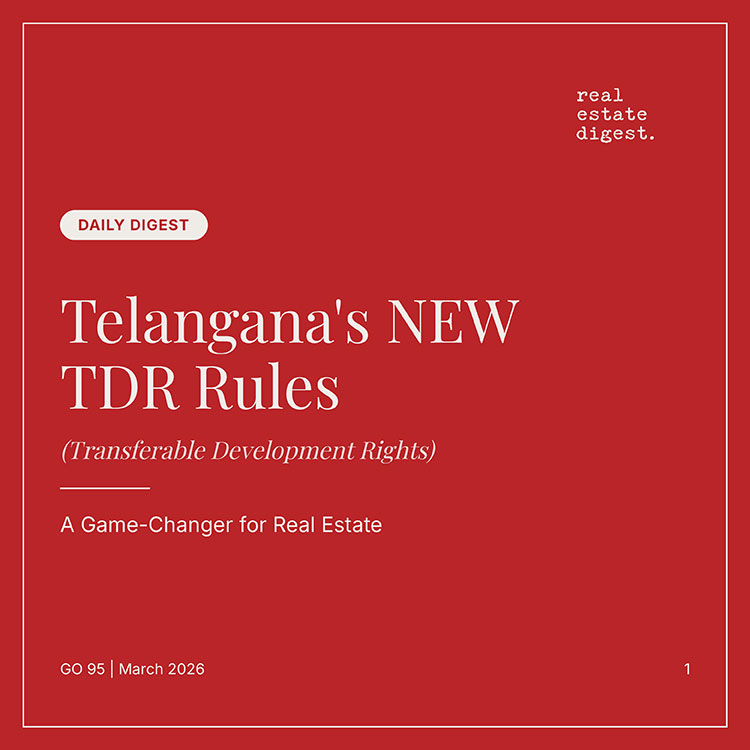
In a major boost to the real estate sector, the Telangana government has introduced significant amendments to building regulations and Transferable Development Rights (TDR) policies. These changes are aimed at accelerating construction activity, improving development feasibility, and unlocking higher land value across Hyderabad and other urban areas.
The reforms come at a time when the sector is witnessing rising construction costs, regulatory delays, and changing demand patterns.
Key Highlights of the Policy Changes
The government has introduced several important provisions:
- Additional floors permitted based on road width
- Relaxation in setback requirements for better land utilization
- Faster approvals for mid-rise and high-rise buildings
- Expanded usage of TDR to support development
These changes are expected to significantly improve project viability and reduce execution timelines.
Major Numerical Highlights
The revised policy includes several important numerical thresholds:
- Buildings located on 30 feet, 40 feet, 60 feet, and 80 feet roads will now have varying permissions for additional floors
- In some cases, developers can construct up to 2,000 square meters and above with greater flexibility
- For smaller plots, construction permissions are eased for areas starting from 750 square meters up to 2,000 square meters
- Earlier restrictions limited optimal utilization, but now projects between 18 meters to 21 meters height can be developed more efficiently
These numerical relaxations directly impact the scale and feasibility of real estate projects.
What is TDR and Its Expanded Role
Transferable Development Rights (TDR) allow landowners to receive development potential in exchange for land surrendered for public infrastructure such as roads or public utilities.
With the updated policy:
- TDR can now be utilized more efficiently in urban projects
- Developers gain flexibility in increasing built-up area
- Government infrastructure projects can be executed faster without direct land acquisition costs
Boost for High-Rise Development
One of the most impactful aspects of the reform is the permission for additional floors based on road width.
This enables:
- Vertical development in high-demand zones
- Better use of limited land resources
- Increased supply of residential and commercial spaces
Areas such as Financial District, Kokapet, Gachibowli, and Tellapur are expected to benefit significantly.
Relief for Developers
The real estate sector has been facing challenges such as:
- Delays in approvals
- High compliance costs
Limited development flexibility
The new policy addresses these concerns by:
- Simplifying approval processes
- Increasing permissible construction limits
- Enhancing overall project feasibility
This is expected to attract both local and national developers to invest more aggressively in Telangana.
Impact on Real Estate Market
Increased Supply
With relaxed norms, developers can launch projects faster, increasing housing supply—especially in mid and premium segments.
Land Value Appreciation
Higher development potential typically leads to an increase in land value, particularly in well-connected areas.
Growth of Emerging Corridors
Peripheral areas with good road infrastructure will become more attractive for large-scale development.
Faster Execution
Simplified approvals will reduce delays and improve project delivery timelines.
Benefits for Homebuyers
Homebuyers stand to gain through:
- More housing options
- Improved project quality
- Faster delivery timelines
- Potential price stabilization due to increased supply
Challenges to Watch
While the reforms are positive, certain aspects need attention:
- Infrastructure must keep pace with increased density
- Urban planning must remain balanced
- Quality control must be maintained
Conclusion
Telangana’s amendments to building rules and TDR usage mark a significant step toward accelerating urban development. By enabling higher construction potential and reducing regulatory hurdles, the government is setting the stage for the next phase of real estate growth.
For developers, this means improved feasibility.
For investors, it signals new opportunities.
For Hyderabad, it represents a move toward a more structured and future-ready urban landscape.